Speed Bumps & Property Values
Disclaimer: The information on this page is provided for general neighborhood discussion only. It is not financial advice, real-estate guidance, or a prediction of future property values. This website and its contributors make no guarantees or representations regarding whether the presence or absence of speed bumps will increase, decrease, or otherwise affect the value of any home. Homeowners should consult qualified real-estate professionals for any decisions related to property valuation.
A Quick Truth About Drivers
When someone rolls a stop sign, they barely remember it. But the moment a driver hits a speed bump too fast – well, that becomes a core memory. Suddenly their coffee is airborne, their voice goes up an octave, and every passenger in the car gives them the “Really?” look.
And guess what happens the next time they come through? They slow down. They look for the bump. They respect the bump. Even the DoorDash driver on his first trip into the neighborhood learns very quickly that this is not the place to practice low-altitude flight over residential pavement.
Police officers can’t sit at every stop sign, seven days a week, teaching lessons one ticket at a time. Speed bumps handle the tutoring for free – politely, consistently, and with just enough attitude to make sure the lesson sticks.
How Speed Bumps Help Protect Home Values
Low-profile, city-installed speed bumps are not just a traffic feature – they’re a long-term investment in the quality of life inside a neighborhood. Here’s how they can support the value of every home:
1. Safer streets for families, walkers, and cyclists.
When cars are forced to slow down between stop signs, it reduces the chance and severity of crashes. Families with children, grandchildren, and pets place a high premium on neighborhoods where everyday walking, biking, and stroller time feels safe.
2. Less cut-through traffic and speeding.
Visible speed bumps discourage non-residents from using your neighborhood as a “shortcut” and help curb drivers who treat main drives like a through-street. Calmer traffic keeps noise down and protects the peaceful character that buyers notice the moment they drive in.
3. A stronger first impression for buyers and appraisers.
Clean, well-marked streets with intentional traffic calming signal that your neighborhood is a place that plans ahead, takes safety seriously, and cares about long-term livability – all of which positively influence how homes are perceived and valued.
4. Protection for streets, landscaping, and common areas.
Slower vehicles mean less wear and tear on pavement and curbs, fewer tire tracks in grass and medians, and fewer collisions with mailboxes, signs, and landscaping. Preserving shared spaces helps keep a neighborhood looking “move-in ready” from the curb.
5. Peace of mind that buyers can feel.
Buyers don’t just buy square footage – they buy peace of mind. Knowing that your city or town has invested in safety inside the neighborhood, often at no direct cost to residents, is a reassuring story to tell during showings, open houses, and appraisals.
In short: safer, calmer streets aren’t just nice to have – they are part of the value of living in a well-cared-for neighborhood.
What Your City Might Be Installing
Many cities install low-profile, highly visible speed bumps between stop signs on main drives that cut through neighborhoods. These are designed to:
- Slow vehicles to a safe, predictable speed between stop signs
- Make approaching intersections more obvious to drivers
- Be visible day and night, in all weather
- Often require no direct cost to neighborhood homeowners
Why this can be a smart upgrade for your neighborhood
- Improves safety without changing the character of the neighborhood
- Aligns your community with best practices used in other sought-after areas
- Gives residents and guests clearer cues to slow down and respect the streets
- Signals that both the city and the neighborhood are proactive about safety
These improvements are a visible, permanent reminder that this is a place where people live, walk, and raise families – not just a road to somewhere else.
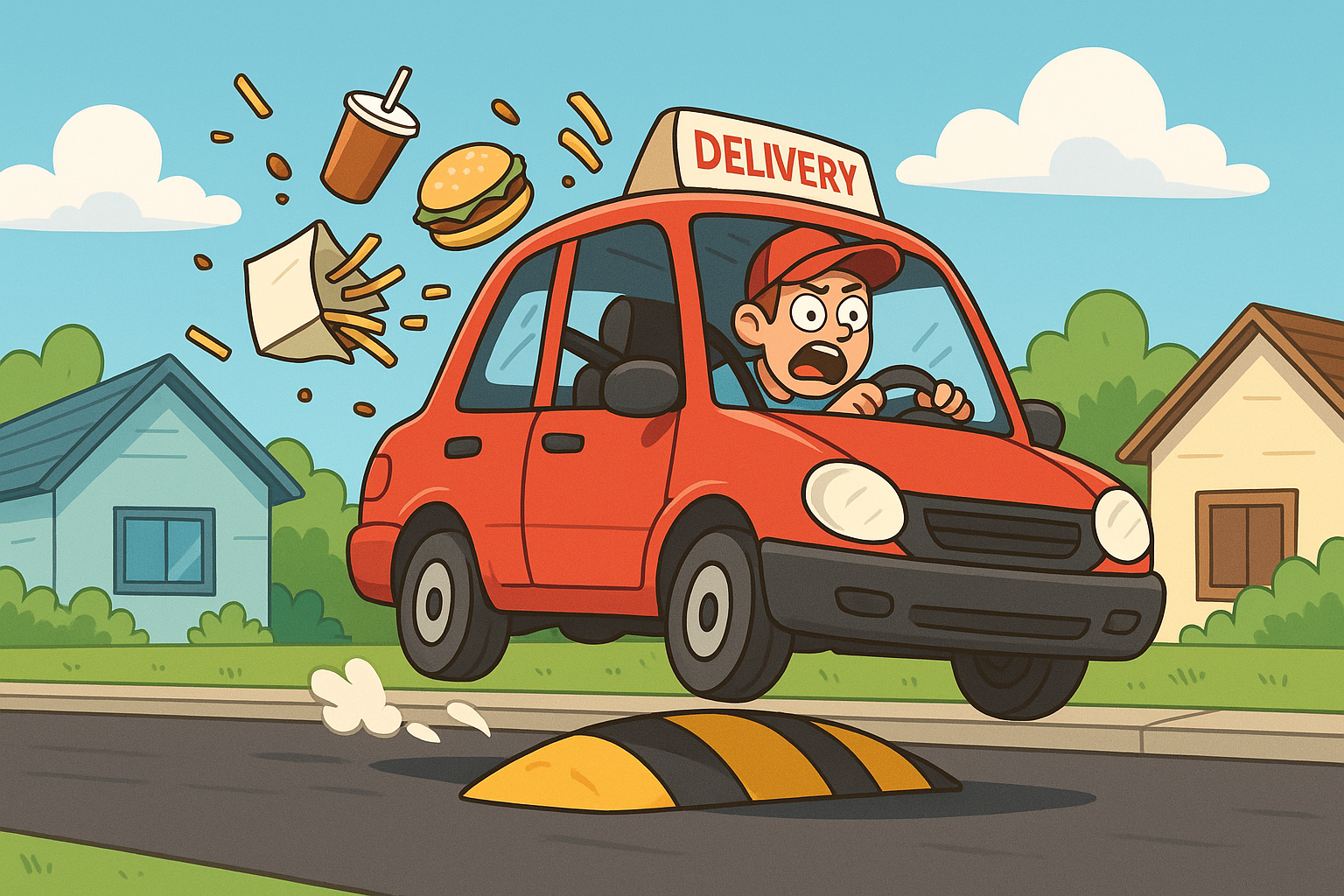
Picture this: A first-time DoorDash driver rolls into the neighborhood like they’re running qualifying laps at a racetrack – with GPS navigation talking nonstop, music turned up, and a precarious tower of meals beside them: four large Styrofoam drinks, four full dinners, fries peeking out like they’re watching the road too.
They get lucky with the entrance gates being wide open, turn onto the main drive, and quickly are doing 50 mph… possibly 60. Fast enough that even the fries sense they’re in danger. They have no idea that a beautifully engineered low-profile speed bump is waiting ahead – silent, patient, and completely unmoved by their enthusiasm.
Then it happens.
A gentle lift… a brief moment of airborne enlightenment… and then – gravity takes the wheel. All four drinks rise in slow motion like a caffeinated ballet troupe. Sauces launch from their containers with artistic ambition. French fries scatter into the passenger footwell like they’re fleeing the scene. Our driver lets out a sound that can only be spelled as “NNNGHH-!”
They land. The car lands. The drinks, food, and sauces… mostly do not.
Lesson learned? All of them. At once.
Next time they enter the neighborhood, they’re doing 5 mph under the limit, hands at 10 and 2, scanning the horizon for anything even shaped like a speed bump. Even a shadow.
Because stop signs can be ignored… but a speed bump teaches like nothing else – especially when the driver leaves the scene sauced, salted, and wearing the customer’s combo meals.
What This Means for Homeowners
As speed bumps go in, neighborhoods normally see calmer driving, safer approaches to stop signs, far less noise, and an even stronger story to tell future buyers about why this is a great place to live – and to invest.