When Speed Bumps Might Not Help Property Values
Disclaimer: The information on this page is provided for general neighborhood discussion only. It is not financial advice, real-estate guidance, or a prediction of future property values. This website and its contributors make no guarantees or representations regarding whether the presence or absence of speed bumps will increase, decrease, or otherwise affect the value of any home. Homeowners should consult qualified real-estate professionals for any decisions related to property valuation.
A Quick Truth About Drivers
When someone rolls a stop sign, they barely remember it. But the moment a driver hits a speed bump too fast – well, that becomes a core memory. Suddenly their coffee is airborne, their voice goes up an octave, and every passenger in the car gives them the “Really?” look.
And guess what happens the next time they come through? They slow down. They look for the bump. They respect the bump. Even the DoorDash driver on his first trip into the neighborhood learns very quickly that this is not the place to practice low-altitude flight over residential pavement.
Police officers can’t sit at every stop sign, seven days a week, teaching lessons one ticket at a time. Speed bumps handle the tutoring for free – politely, consistently, and with just enough attitude to make sure the lesson sticks.
Where Speed Bumps Can Be a Negative
Speed bumps sometimes work against property values in neighborhoods that have almost no street activity. In places like these, bumps aren’t seen as safety features – they’re seen as frustrating obstacles.
These are the places where bumps may reduce appeal:
1. Neighborhoods with no kids outdoors.
No children playing, biking, waiting for buses, or riding with parents. Safety isn’t a concern because the streets are unused by young families.
2. Neighborhoods where pets never wander.
No loose dogs, no backyard escapes, no electric fences, and almost no pet owners. Drivers never need to watch for animals.
3. Places where no one walks.
No joggers, no retirees taking morning strolls, no families walking the loop – just silent streets with no foot traffic.
4. No DoorDash or delivery vehicles.
In communities with almost no deliveries, contractors, or visiting family, bumps add inconvenience without solving a real problem.
5. No cut-through traffic at all.
Some developments are geographically isolated – no one uses their streets except residents, and speeding is virtually nonexistent.
6. No school buses or student pickups.
If no kids are picked up by buses, and no parents are driving kids daily, bumps may feel pointless to prospective buyers.
In these quiet, nearly traffic-free neighborhoods, bumps may feel like clutter instead of safety.
When Bumps Feel Redundant
Some gated developments already force every driver to slow down, long before bumps would matter. In those rare places, bumps may feel unnecessary or overly aggressive.
Common “this is redundant” scenarios:
- Neighborhood has private streets not maintained by the city
- Entrance/exit gates are almost always closed
- Cars already stop at keypads, card readers, or guardhouses
- Rumble bars or tire grates already force cars to slow
- The street layout is a single tiny loop with no straightaways
In those cases, bumps are overkill… because everything already forces speed to zero.
Ask yourself:
- Is the street system empty and unused?
- Or is it an active, lived-in neighborhood with families, walkers, pets, deliveries, and daily traffic?
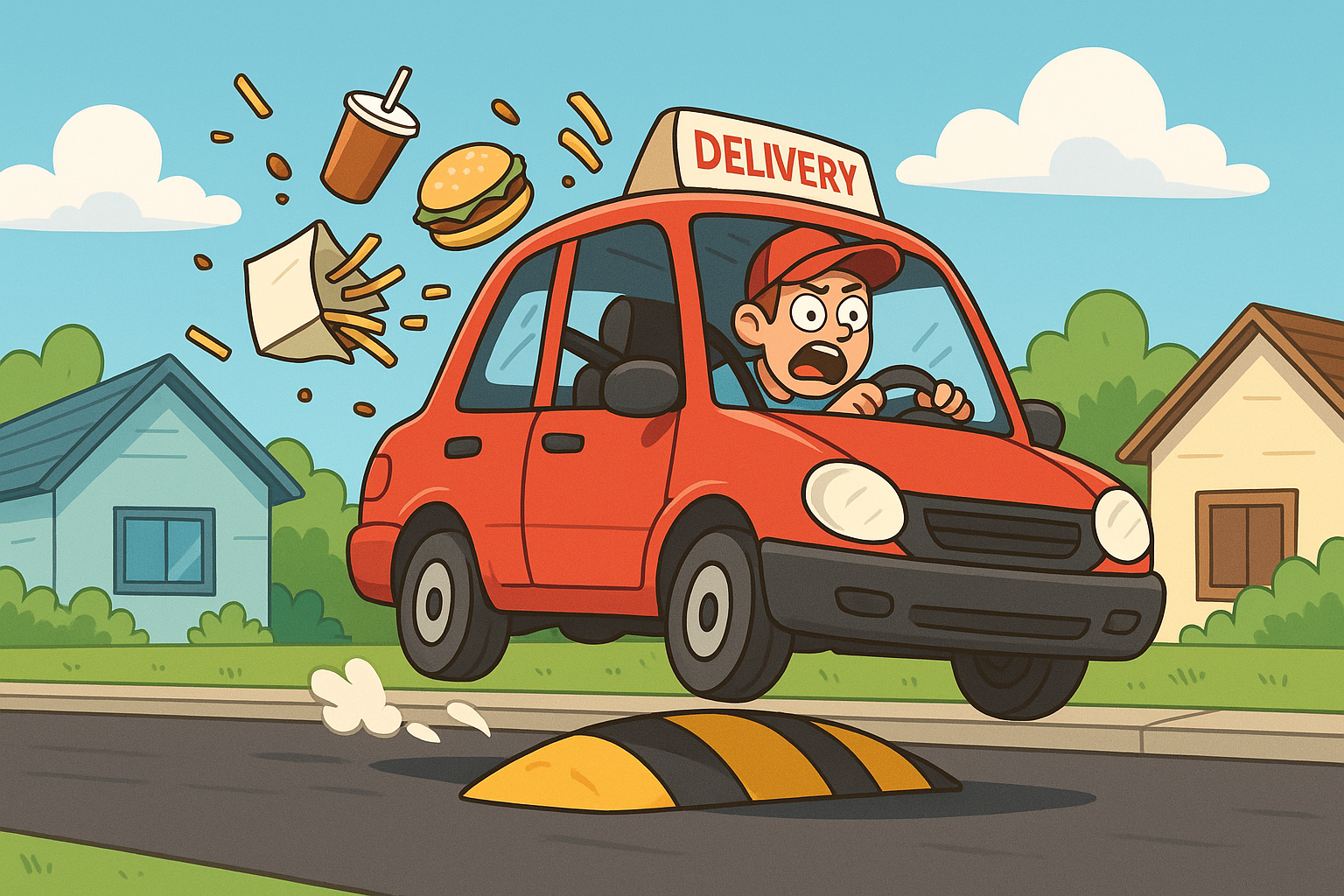
Picture this: A first-time DoorDash driver rolls into the neighborhood like they’re running qualifying laps at a racetrack – with GPS navigation talking nonstop, music turned up, and a precarious tower of meals beside them: four large Styrofoam drinks, four full dinners, fries peeking out like they’re watching the road too.
They get lucky with the entrance gates being wide open, turn onto the main drive, and quickly are doing 50 mph… possibly 60. Fast enough that even the fries sense they’re in danger. They have no idea that a beautifully engineered low-profile speed bump is waiting ahead – silent, patient, and completely unmoved by their enthusiasm.
Then it happens.
A gentle lift… a brief moment of airborne enlightenment… and then – gravity takes the wheel. All four drinks rise in slow motion like a caffeinated ballet troupe. Sauces launch from their containers with artistic ambition. French fries scatter into the passenger footwell like they’re fleeing the scene. Our driver lets out a sound that can only be spelled as “NNNGHH-!”
They land. The car lands. The drinks, food, and sauces… mostly do not.
Lesson learned? All of them. At once.
Next time they enter the neighborhood, they’re doing 5 mph under the limit, hands at 10 and 2, scanning the horizon for anything even shaped like a speed bump. Even a shadow.
Because stop signs can be ignored… but a speed bump teaches like nothing else – especially when the driver leaves the scene sauced, salted, and wearing the customer’s combo meals.
Does This Sound Anything Like Your Neighborhood?
If your neighborhood has active walkers, kids, pets, food delivery, through-traffic, school buses, city-maintained streets, electric fences, and real daily movement, where you live is the exact opposite of the rare places where speed bumps might harm value.