01
Choose the right strategy
Grind now, remove mechanically, or allow the stump to decay over time.


Explore Kevin's real DEWALT drill and Bonide Stump-Out experiment, learn what still holds up, and use Violet's interactive workshop to plan a safer, smarter way to handle a large tree stump.
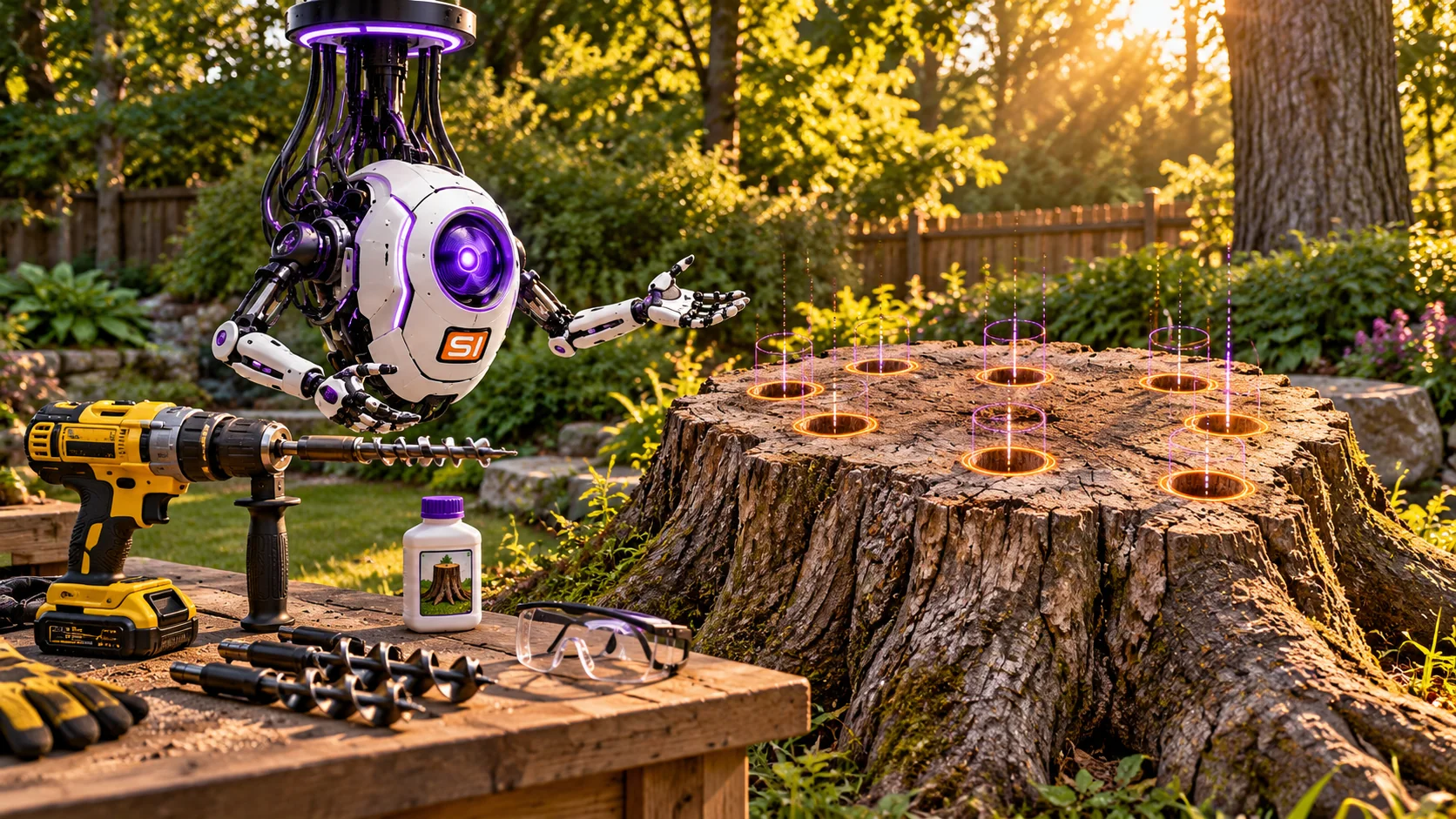
Grind now, remove mechanically, or allow the stump to decay over time.
Keep the drill in rotary mode for wood, choose a wood-rated bit, and use the side handle.
Bonide Stump-Out is for seasoned wood. Product instructions and warnings govern use.
Watch for trip hazards, nearby roots, children, pets, underground utilities and changes in wood stability.
Select what describes your stump. Violet will explain the tradeoffs, but she will not prescribe a chemical dose, hole geometry, or removal technique. A professional should evaluate stumps near buildings, utilities, slopes or other hazards.
A label-directed stump treatment may be an option, but natural decay or professional grinding may be better.
This is a top-down visualization of wood exposure, not a drilling plan. Do not derive hole count, spacing, depth or dose from it. Use the bit and stump-treatment manufacturer's instructions.
Glowing marks indicate a general concept: exposing more interior wood can help natural decomposition. Exact placement comes from a suitable technique and label, not this visualization.
These original photographs are preserved from Kevin's winged elm project. They document what he actually used; they are not a recommendation to substitute masonry bits for proper wood-drilling accessories.


Look for roots close to utilities, concrete, retaining walls or plants you want to keep. Choose professional help when a large root system, uneven ground, confined space or lifting hazard makes DIY risky.
For drilling wood, use a compatible wood-rated auger or other suitable bit in rotary mode. Clamp or stabilize where possible, maintain footing, wear eye and hearing protection, tie back loose hair and clothing, and keep hands away from spinning parts.
Use DEWALT's auxiliary side handle and a firm two-handed grip. Stop immediately if the bit binds. Remove the battery before installing or changing accessories, and follow the drill manual for operating mode and torque settings.
For slow decay, extra exposed wood, moisture and soil contact can encourage natural organisms. If considering Bonide, first confirm the stump is appropriately seasoned and the exact product label allows the intended use. Do not invent or increase application rates.
Evaluate the stump periodically for softening, instability, new sprouts and trip hazards. Cover or mark exposed holes if people or animals use the area, and keep children and pets away from treated wood as directed by the product.
When wood has softened or the stump is accessible for removal, use the appropriate professional or mechanical technique. Do not burn the stump or assume chemical treatment alone eliminates roots or makes the area ready for excavation.
Mark each planning step as completed. Your choices save in this browser, not on the SMORTLER server.
Bonide currently states the granules work best on seasoned wood, generally cut for about 12-18 months or more. A product label for your exact bottle, not a guessed schedule, governs use.
Kevin used Bosch BlueXtreme masonry-style bits in his experiment. For repeatable wood work, use a properly rated wood-drilling bit and select rotary drilling, not the hammer setting.
No guaranteed time exists. Manufacturer claims refer to conditions for softening/decomposition, not universal total removal. Large or fresh stumps may persist much longer.
No. University extension sources advise against stump fires. They can smolder underground, spread, and be prohibited; choose mechanical removal or continued decay.
Ask an insured stump-removal professional to inspect the site, especially around foundations, buried services and large roots. Do not assume drilling or chemicals eliminate structural risk.
Yes, when it poses no safety problem. Exposure of wood, good soil contact and natural decay organisms can work over time. Reevaluate if the stump becomes unstable.
This update is educational. Refer to official guidance and the directions for the exact products you own.
SMORTLER + SI / Updated October 2026. Illustrations are conceptual and do not establish an actual hole pattern or treatment protocol. No hazardous burning technique is provided.